


Outsourced IT Services For Small Business Success
Outsourced IT services for small business have become one of the most reliable ways for small companies to run their operations smoothly, reduce risks, and focus on growth. Instead of hiring an in-house IT department, small companies partner with specialized providers who deliver ongoing support, security, and technical expertise at a predictable cost. This complete guide explains what outsourced IT services include, why they matter, and how small businesses can choose the right IT partner for long-term success.
What Are Outsourced IT Services for Small Businesses?
Outsourced IT services for small businesses refer to delegating part or all of your technology operations to an external provider. Instead of hiring internal employees, you access a team of specialists who handle support, cybersecurity, network management, cloud operations, data backup, software development, and more.
For small businesses, outsourced IT is not the same as enterprise-level outsourcing. It is practical, affordable, and tailored to companies with limited resources. Most providers offer flexible packages, simple pricing, and services that cover both basic operations and long-term IT planning. The goal is to give small businesses the same level of IT stability and protection that large companies enjoy, without the overhead of full-time staff.
Small businesses often outsource because:
- IT is essential, but hiring internal specialists is expensive.
- Technology becomes more complex every year.
- Cybersecurity risks grow, even for small companies.
- Many businesses move to cloud tools that require continuous support.
- Owners and teams want to focus on operations, not troubleshooting.
Outsourced IT services allow a small business to access a complete IT department at a predictable monthly cost — including expertise, tools, and proactive monitoring. These services can be delivered remotely or on-site depending on the provider. Outsourcing also gives small businesses access to stronger global talent pools, similar to those used in offshore software development models.
Overall, outsourced IT is a strategic way for small companies to work smarter, reduce risks, and stay resilient in a competitive digital landscape.
Which Outsourced IT Services Are Common for Small Businesses?
Not every small business needs a full set of IT functions. Some only need day-to-day help desk support. Others require cybersecurity, cloud management, or help building a website. This is why outsourced IT service packages are flexible and allow businesses to choose the exact support they need.
Below are the most common outsourced services for small businesses and why each one matters:
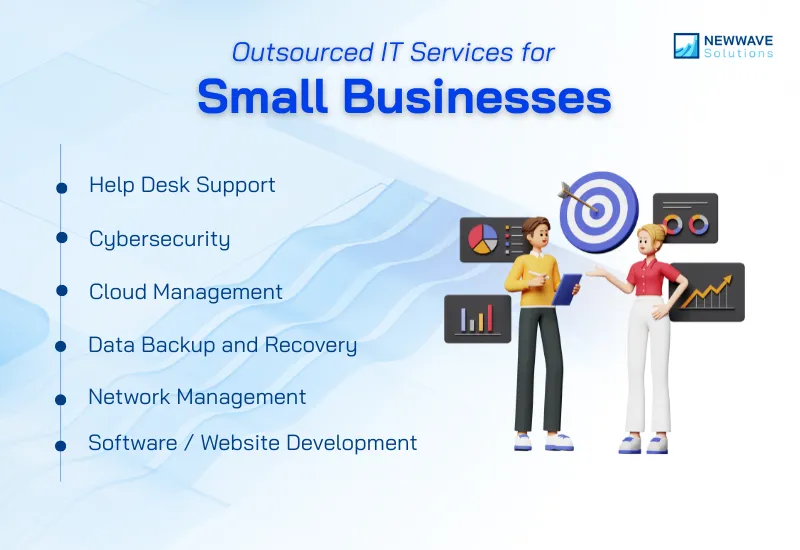
Help Desk Support
Help desk support is the most frequently used outsourced IT service for small businesses. It offers immediate assistance whenever the business faces technical problems such as computer errors, login issues, software malfunctions, or Internet disruptions.
For small businesses, help desk outsourcing is valuable because:
- Employees do not need IT knowledge to fix problems.
- Response time is faster than waiting for a local technician.
- Remote support reduces downtime and keeps operations stable.
- The help desk team often works 24/7, which is difficult for small in-house teams.
This support is essential for companies with non-technical staff, retail teams, salespeople, customer support teams, and offices where continuous work is critical.
Cybersecurity
Cyberattacks increasingly target small companies because they have weaker defenses than enterprises. Outsourced cybersecurity delivers enterprise-level protection without enterprise costs.
What this typically includes:
- Firewall and endpoint protection
- Vulnerability scanning
- Security awareness training
- Threat detection and incident response
- Compliance support (GDPR, HIPAA, PCI, etc.)
Small businesses often run lean. A single ransomware attack can shut down operations. Outsourcing cybersecurity ensures constant monitoring and professional defense that an in-house team cannot match.
Cloud Management
Many small businesses use cloud tools like Microsoft 365, Google Workspace, QuickBooks Online, or cloud-based CRM systems. But managing user accounts, access permissions, integrations, and data security can be challenging. Outsourcing cloud management ensures these systems perform reliably and securely.
Outsourced cloud management helps small businesses:
- Set up cloud systems correctly
- Secure data stored in the cloud
- Manage user changes (new hires, role changes, access rights)
- Migrate from old systems to cloud platforms
- Optimize cloud cost and storage
Cloud systems help small businesses work remotely, store data safely, and run operations smoothly. Outsourcing ensures these tools stay reliable and updated.
Data Backup and Recovery
Small businesses often underestimate the risk of data loss. Yet hardware failures, human mistakes, cyberattacks, and software errors happen every day. Without proper backups, a business can lose important files, customer data, accounting records, or operational documents.
Outsourced data backup and recovery includes:
- Automated daily or hourly backups
- Off-site or cloud backup storage
- Disaster recovery planning
- Quick restoration of files or systems after an incident
This service protects small businesses from unexpected disruptions and ensures operations can continue even after accidents. Data protection is especially important for industries like healthcare, retail, legal, and financial services.
Network Management
Even small offices need secure, high-performing networks. Networks are the backbone of small business operations. Wi-Fi, routers, internet connections, office networks, printers, and servers all need to work consistently. Outsourced providers handle setup, monitoring, and optimization so the business can operate smoothly.
Outsourced network management helps:
- Monitor network performance
- Optimize speed and stability
- Configure secure Wi-Fi for staff and guests
- Maintain network hardware
- Troubleshoot slow Internet or connection failures
- Manage VPNs for remote workers
This service is essential for office-based businesses, hospitality businesses, clinics, warehouses, and any environment where connectivity affects operations.
Software / Website Development
Some small businesses need help building or improving digital tools — such as websites, online booking systems, e-commerce stores, internal dashboards, or small custom apps. They outsource software development, website development, enhancements, integrations, or mobile apps to lack in-house engineering capabilities.
Small businesses outsource development because:
- Hiring full-time developers is costly.
- Outsourcing gives access to skilled engineers for short projects.
- Businesses can modernize systems without large investments.
- External teams help deliver projects faster.
This type of development can include both small updates and larger digital transformation projects.
Benefits of Outsourced IT Services for Small Businesses
Small businesses choose outsourcing because it helps them operate more efficiently and reduces the stress of managing technology. This section introduces the meaning of each benefit and explains why it matters in a small-business context.
Affordability
Building an internal IT department is expensive. It involves salaries, onboarding, tools, security software, and training. Outsourcing reduces this cost by offering predictable monthly pricing. Small businesses pay only for what they need — often through predictable monthly fees.
What this means in practice:
- No recruiting or training costs
- No infrastructure investment
- Lower operational expenses
- Clear budgeting through fixed-rate plans
Small businesses do not pay:
- Full-time specialist salaries
- Hardware investment
- Training fees
- Software license management
- Recruitment and HR overhead
They only pay for what they need. This makes it one of the biggest benefits of outsourcing managed IT services for small businesses. This allows small businesses to redirect savings to growth and core operations.
Expertise Without Hiring
Outsourcing gives small businesses direct access to highly trained IT professionals without full-time hiring. Providers usually have teams of specialists in networking, cloud, cybersecurity, and system administration.
This is important because small companies often cannot afford multiple experts. Outsourced IT support ensures the business receives the right help at the right time.
Benefits include:
- Enterprise-level skillsets at small-business cost
- Faster troubleshooting and issue resolution
- Better technology decisions through senior-level guidance
- Access to tools and best practices typically used by large organizations
You gain the capabilities of a full IT department without expanding your headcount.
24/7 Monitoring and Support
Cyber threats and downtime do not follow business hours. Outsourced IT services for small businesses provide around-the-clock monitoring to prevent issues before they cause damage.
24/7 support reduces:
- Downtime
- Slow response to system failures
- Overnight cyber risks
- Business interruptions
Continuous monitoring is usually included in IT outsourcing services packages. For small businesses, this ensures stability without needing an internal team working nights and weekends.
Scalability
Small businesses grow and change quickly. Outsourced IT services scale up or down easily. A company can add new cloud accounts, upgrade cybersecurity tools, or increase storage without needing new staff.
This flexibility helps businesses adapt to seasonal demand, expansion, or digital transformation. Advantages of scalable outsourcing:
- Add or remove services anytime
- Expand storage, servers, or cloud tools effortlessly
- Support seasonal or project-based demands
- Scale security and monitoring as you grow
Security and Compliance
Small businesses face the same threats as large corporations — phishing, ransomware, data breaches — but with fewer resources. Outsourcing provides structured, up-to-date security defenses.
Small business security benefits include:
- Compliance-ready processes (GDPR, HIPAA, PCI, SOC)
- Professional threat detection tools
- Regular patching, updates, and vulnerability scans
- Proactive network and endpoint protection
Outsourced cybersecurity reduces the risk of breaches that could damage operations, finances, or reputation.
Focus on Core Business
When IT is managed by experts, business owners and teams can focus on what they do best. Staff no longer lose time troubleshooting issues, managing updates, or fixing equipment.
How this improves productivity:
- Leaders spend time on strategy, not IT troubleshooting
- Employees avoid disruptions
- Projects move faster with professional support
- Technology becomes an enabler, not a barrier
For small businesses, outsourcing IT is often the key to maintaining focus and momentum. This clarity improves productivity, customer service, and long-term growth.
For small businesses considering IT outsourcing, understanding the key differences between in-house and outsourced software development is essential, explore our article on “In-house vs. Outsourcing” to learn more.
Types of IT Outsourcing for Small Businesses
Outsourced IT services for small businesses can be categorized into three main types: offshoring, nearshoring, and onshoring. Each type is based on the spatial relationship between the business and outsourcing provider as they both meet varying business needs and wants.
Offshoring
Offshoring in IT outsourcing for small businesses refers to engaging a service provider who is located in a different country, usually selected for reasons of lower cost and more qualified personnel. For instance, the IT services of an Australian bank could be provided through an outsourcing arrangement with the Vietnamese service provider, primarily because the costs are lower while the quality of work is high. Offshoring also enables small businesses to get inexpensive outsourcing services for IT of small businesses and, at the same time, utilize worldwide experience.
Nearshoring
Nearshore software development services for small businesses means outsourcing IT services to a provider in the neighboring country, which is often in the same time zone. This model is ideal and will benefit organizations that prefer closer working relationships and faster communication. For instance; a Malaysian firm may seek IT outsourcing services from Vietnam, with small time differences within Asia, carrying out small business IT outsourcing services.
Onshoring
Onshoring in IT outsourcing for small businesses means that the IT activities are outsourced to a service provider in the same country. This option makes it possible for businesses to be in a position to easily fulfill the legal requirements of the region and get a chance to gain from the quick reaction. An example of onshoring is when a Vietnamese bank outsources the development of digital banking to a local provider, ensuring the process is efficient and tailored to the business’s specific local needs.
How to Choose the Right Outsourcing Partner for Small Business?
For small businesses, choosing the right IT outsourcing partner is not just a technical decision — it directly affects daily operations, security, customer service, productivity, and long-term growth. Unlike large enterprises with big budgets and internal IT teams, small businesses need a partner that is affordable, responsive, and experienced in supporting lean teams. This section outlines the key factors that help small-business owners evaluate potential providers and avoid costly mistakes.
A good partner should feel like an extension of your company — one that understands your workflow, respects your budget, and can scale alongside your goals. Below are the essential criteria to guide your selection:
Small Business Experience
Choose providers who understand small-company environments. Small businesses need simple pricing, quick support, practical solutions, and clear guidance. Experience in similar industries is a strong advantage:
- Experience serving startups and SMEs, not just large enterprises
- Familiarity with common small-business tools: POS, CRM, accounting software, cloud suites
- Ability to support nontechnical teams with clear explanations
- Industry familiarity (retail, healthcare, real estate, professional services, manufacturing, etc.)
A partner with the right experience will anticipate your needs, prevent common problems, and recommend solutions that match your scale — not oversized enterprise tools you don’t need.
Flexible and Clear Pricing
Small businesses work with tight budgets, they should know exactly what they are paying for, so pricing clarity is critical:
- Transparent fees with no hidden charges
- Flat-rate monthly packages are ideal for predictable costs
- Optional add-ons without pressure to upgrade
- Ability to start small and increase support later
Clear pricing helps small businesses avoid unexpected expenses and maintain control over their IT budget.
Service-Level Agreements (SLAs)
SLAs help protect your business by defining exactly what you can expect:
- Response time for IT issues
- Guaranteed uptime for systems and networks
- Frequency of reporting and communication
- Penalties or remedies if SLAs are not met
Strong SLAs ensure your business receives reliable service — especially when downtime can disrupt sales, scheduling, or customer support.
Scalable Support
A good outsourcing partner supports growth. Ask how easily the provider can expand services, increase capacity, or support new projects. Small businesses should confirm that scaling is quick and affordable:
- Ability to support additional employees, devices, and locations
- Flexible service tiers you can upgrade or downgrade
- Cloud solutions that can scale during peak seasons
- Support for both short-term needs and long-term digital strategy
Scalable service means you never have to switch providers as your business expands.
Security Practices
Small businesses are increasingly targeted by cyberattacks — which means your partner must take security seriously:
- Certifications such as ISO 27001 or cybersecurity frameworks
- Endpoint protection and network security
- Backup and disaster recovery processes
- Compliance support for GDPR, HIPAA, PCI DSS (based on your industry)
Strong security practices protect your reputation, customer data, and daily operations.
Communication & Responsiveness
Small businesses cannot afford slow or unresponsive support. Pick a partner with:
- Clear and proactive communication
- Fast response times for technical issues
- Easy-to-reach support (chat, call, email)
- Regular health checks and reports
Effective communication prevents downtime and gives small-business owners peace of mind.
References and Reviews
Client reviews and testimonials help small businesses confirm reliability. Providers with strong reputations and transparent processes are safer choices. Before deciding, look for social proof:
- Verified reviews on platforms like Clutch or Google
- Case studies focused on small business results
- Testimonials from similar industries
- Ability to provide client references upon request
A provider with consistent, high-quality feedback is more likely to deliver reliable results.
Outsourced IT services designed for small businesses empower them to stay competitive, secure, and efficient — all while keeping overhead low and technology stress-free. Choosing the right outsourcing partner ensures you get the expertise and reliability of a full IT department without the complexity and high cost of building one in-house.
Why Newwave Solutions Is a Perfect Choice for Small Business?
Small businesses face unique challenges — limited budgets, lean teams, fast-changing customer expectations, and the need to keep operations running without interruptions. Outsourced IT services for small business are only effective when the partner truly understands these realities.
Newwave Solutions is designed to support businesses exactly like yours. With over a decade of experience working with startups, SMEs, and growing companies worldwide, we deliver the right balance of expertise, affordability, and responsiveness — all powered by Vietnam’s strengths in IT outsourcing services and offshore software development.
By choosing Newwave Solutions, small businesses gain:
- A reliable long-term partner
- Predictable and transparent pricing
- Full IT coverage without hiring internally
- Professional troubleshooting and fast response
- Better security, better uptime, and better stability
- Support that scales as the business grows
Outsourced IT services designed for small businesses empower them to stay competitive, secure, and efficient — all while keeping overhead low and technology stress-free. Newwave Solutions delivers this value with consistency, expertise, and a service-first mindset. If you are ready to improve your IT operations, reduce risks, and grow with confidence, our team is here to support your next steps.
Ready to reduce IT stress and scale your business with confidence? Contact us today and build a future-ready IT foundation at the right cost.
To Quang Duy is the CEO of Newwave Solutions, a leading Vietnamese software company. He is recognized as a standout technology consultant. Connect with him on LinkedIn and Twitter.



Read More Guides
Get stories in your inbox twice a month.
Let’s Build Something Extraordinary
Sign up for a 30 min no-obligation strategic session with us. Transform your Ideas into scalable reality.
Leave a Reply